Bedding · Materials & sleep temperature
Wool Mattress Toppers: Temperature, Feel, and Care Considerations
A wool mattress topper can soften a bed, alter how warmth and moisture behave at the surface, and introduce a texture quite different from foam or cotton. Before choosing one, it helps to look beyond the appealing shorthand of “natural” and consider what wool actually does, how the topper is built, and what its care label expects of you.
A bed is a small climate. It has weather, though the forecast is usually made by a person turning over at three in the morning and deciding that one foot must be put outside the covers. Sheets, blankets, room temperature, a sleeper’s own heat, and the layers between the body and mattress all contribute. A topper joins this private meteorological system—not as a cure for every restless night, but as one more material with its own habits.
Wool mattress toppers are often chosen for their gentle cushioning and their reputation for balancing warmth and moisture. That reputation has a basis in wool’s fibrous structure, but it is not a promise that every sleeper will feel cool, dry, or comfortable in every climate. The result depends on the amount and arrangement of fill, the cover, the mattress beneath it, the bedding above it, and, not least, the person sleeping there.
The useful questions are practical ones. How much does the topper change the bed’s feel? Is the wool a thick fill, a quilted layer, or part of a combination with another material? How does it attach? What does its care label permit? And will its particular maintenance requirements suit the rhythms of a household that may already be negotiating laundry day with some reluctance?
What a wool topper can—and cannot—change
A mattress topper is a layer placed on top of a mattress, usually beneath a fitted sheet. Its most immediate effect is tactile: it can make a sleep surface feel softer, more cushioned, or more padded. A wool-filled topper may add a pliable, gently lofty layer, though the amount of cushioning varies substantially by design. A thin quilted pad will not behave like a deep, heavily filled topper, and neither should be expected to transform a mattress whose support is failing.
It is useful to distinguish a topper from a mattress pad. The terms are sometimes used loosely, but a pad generally emphasizes a modest change in surface feel or protection, while a topper is more often intended to provide a noticeable layer of cushioning. The boundary is not perfectly consistent across the bedding trade. Construction and thickness tell you more than the name on the packaging.
Wool is also not a substitute for mattress support. If a bed has a pronounced sag, a broken foundation, or a shape that leaves you persistently uncomfortable, adding a soft layer may disguise the problem briefly without correcting it. A topper is best understood as an adjustment to the surface, not an orthopedic repair or a treatment for a sleep disorder.
For some sleepers, the attraction is not dramatic plushness but moderation: a little softness without the dense, enveloping impression associated with certain foams. Others may find wool too subtle, too warm, or simply unlike the feel they want. Preferences are personal, and the same topper can seem pleasantly yielding to one person and insufficiently cushioned to another.
Temperature: an exchange, not a thermostat
Wool is commonly described as temperature-regulating. The phrase can be useful, provided it is not mistaken for active temperature control. A wool layer does not sense that a sleeper is warm and turn itself into a cooling device. Rather, the fibers and the structure of the bedding influence how heat and moisture move or remain near the body. The experience is shaped by the whole sleep system: mattress, topper, sheets, blankets, room conditions, and individual differences.
Wool fibers can take up water vapor, and wool-filled bedding may help manage some of the moisture produced during sleep. This is one reason wool is often considered by people who want a layer that feels less clammy than some tightly packed, low-airflow materials. But moisture handling is not the same as waterproofing, and it does not mean a wool topper will stay comfortable under every set of conditions. A humid room, heavy bedding, a warm mattress, and a naturally hot sleeper may still combine to create an uncomfortably warm night.
Airflow matters, too. A topper with a breathable cover and a relatively open construction may feel different from one with dense quilting or a tightly woven casing. The fitted sheet and any waterproof protector placed above or below the topper can also affect the way heat and moisture move. A highly protective layer may be useful for household reasons, yet it can change the sensation of the bed. In bedding, one layer rarely acts alone; the sheet set is more ensemble than soloist.
Wool can be insulating as well as moisture-managing. In a cool bedroom, that quality may be welcome. In a warm bedroom, or for someone who already sleeps hot, additional fill could feel like too much. The word “breathable” does not mean “always cool,” just as a wool sweater can be comfortable in one circumstance and excessive in another. If temperature is the main concern, consider the full layering arrangement before attributing the bed’s climate to any single fiber.
Seasonal changes may affect the verdict. Someone who appreciates a wool topper in winter may prefer a lighter surface in summer, while another person may find the same layer comfortable year-round. There is no universal seasonal rule. Room temperature, bedding habits, personal comfort, and how much fill the topper contains are more informative than a blanket claim about wool being inherently warm or cool.
Feel, loft, and the matter of construction
Wool fill is generally experienced as cushioning rather than as a sharply defined support material. Its feel depends on the quantity of wool, how it is distributed, the quilting pattern, and the materials around it. A topper with shallow, closely spaced quilting may feel relatively even and restrained. A deeper construction may create more loft, but it can also be heavier, warmer, or more demanding to maintain.
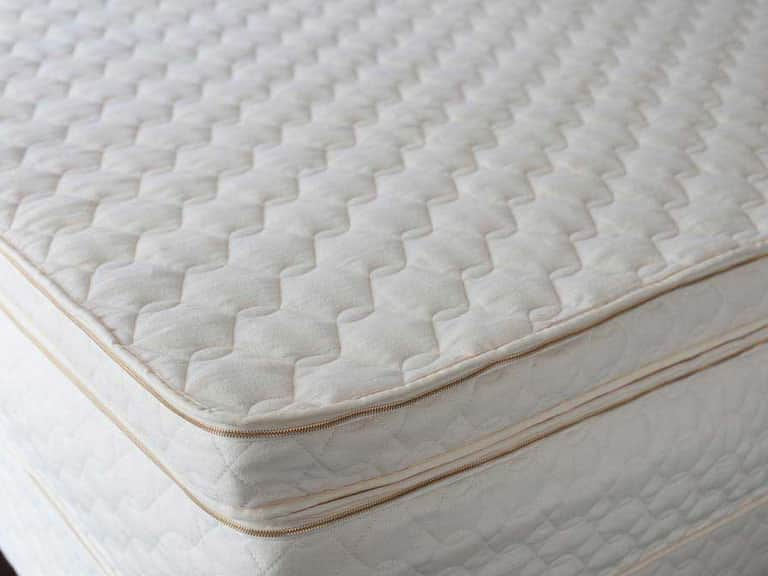
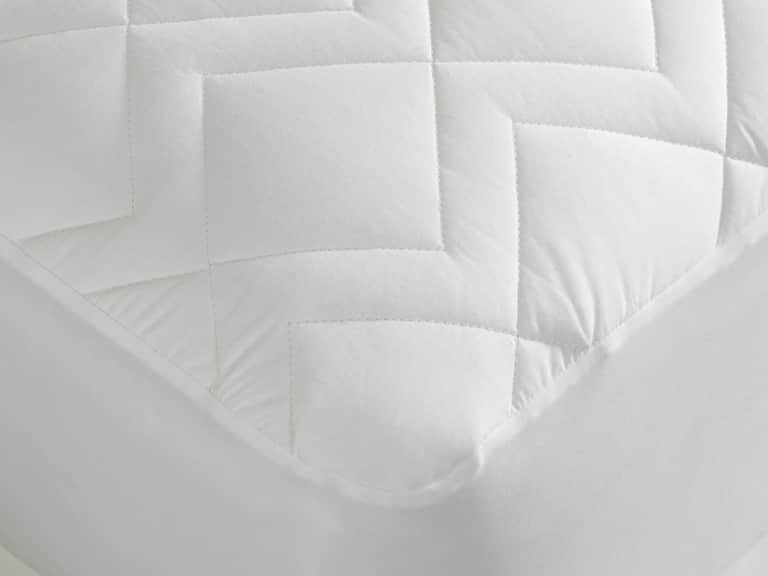
Quilting is not merely decorative. Stitching helps keep filling in place and limits the degree to which it can migrate. A sewn-through pattern, for example, creates fixed sections in the fill. The pattern, spacing, and depth can affect how evenly the topper lies, whether the surface develops noticeable compartments, and how it feels under a fitted sheet. The cover fabric is equally important: cotton, for instance, can provide a familiar textile surface, but different weaves and weights produce different impressions.
Read the material description carefully. A product described as a wool topper might be filled entirely with wool, or it might combine wool with latex or another material. In a combination design, each layer contributes to the feel. A wool quilted casing around a latex insert is not the same experience as a topper made from wool fill alone. The precise construction is therefore more useful than a broad label.
One example of this distinction is the Savvy Rest Harmony Latex Topper. It combines a three-inch Talalay latex insert with a quilted cover containing wool and organic cotton, for a stated overall height of about four inches. It is not a wool-only topper; the latex is a substantial part of its cushioning and support character. The example is useful because it shows why shoppers should examine every layer rather than infer a product’s feel from the word “wool.”
Texture can also be mediated by the cover and by the sheet. Wool fill is usually enclosed, so the sleeper is not necessarily in direct contact with the fiber. Still, the cover’s weave and the topper’s overall loft influence what is felt through a fitted sheet. If you are sensitive to texture, examine the cover composition and, where possible, try the sleep surface in person or review the return terms before committing.
Fit: the quiet mechanics of a tidy bed
A topper that shifts every night can turn an otherwise simple bedding choice into a minor domestic negotiation. Fit begins with mattress dimensions, but it also involves mattress depth, topper dimensions, and the attachment method. Some toppers use elastic corner bands; others rely on their weight, a fitted construction, or the fitted sheet to hold them in place. None is automatically best for every bed.
Measure the mattress rather than relying solely on its label. Standard size names are helpful, but mattress dimensions can vary, and a thick mattress may require deep-pocket sheets even when its length and width are conventional. If the topper extends beyond the mattress, wrinkles or overhang may result. If it is undersized, the exposed edges can be noticeable, particularly for someone who sleeps near the side of the bed.
Consider the full stack. A mattress protector, topper, and fitted sheet all occupy space, and a sheet that fitted snugly before may no longer have enough depth. The elastic may pull at the corners, lift during the night, or flatten the topper’s loft. Check the combined height and the sheet’s pocket depth before deciding that an otherwise promising layer has somehow made the bed misbehave.
Attachment also affects maintenance. A topper with corner straps may be easier to reposition after laundering or airing, though straps can loosen or shift depending on the mattress. A loose layer may be simple to remove but may need occasional smoothing. Think about how often you change sheets and whether you want to lift, fold, or carry the topper during that routine.
Care: wool rewards attention to the label
Wool bedding can require more specialized care than a machine-washable cotton or synthetic pad. The care instructions depend on the actual construction, including the fill, cover, quilting, and any additional materials. Some items may call for dry cleaning; others may permit gentle washing. The fiber name alone is not a care plan, and general advice found online should not override the manufacturer’s instructions.
Before buying, look for the exact cleaning method, not merely a reassuring phrase such as “easy care.” Check whether the topper can be washed at home, whether it must be professionally cleaned, whether spot cleaning is allowed, and whether it can be tumble-dried. A topper that cannot tolerate ordinary laundering may be perfectly workable in one household and inconvenient in another. There is no virtue in discovering this only after a spill.
A removable, washable cover can simplify routine upkeep, if the design includes one. If it does not, using a washable mattress protector over the topper may help shield it from everyday moisture and soil. That additional layer will change the surface slightly, so consider breathability and fit as well as protection. It is a practical compromise, not a guarantee that the topper will never need cleaning.
For a care routine, begin modestly. Follow the label, address small marks as directed, and allow the topper to dry fully if its instructions permit any damp cleaning. Do not assume that prolonged direct sunlight, vigorous beating, high heat, or an improvised wash cycle is harmless. Wool and the materials holding it together can respond differently to heat, agitation, and moisture. A precaution that seems old-fashioned may be less troublesome than a topper that has shrunk or felted.
Storage deserves some thought as well. If the topper is taken off the bed seasonally, store it according to its care guidance in a clean, dry place. Avoid compressing it for long periods unless the manufacturer says that is acceptable. Keep it away from damp conditions, and make sure it is dry before putting it away. Routine airing may help bedding feel fresher, but it is not a substitute for cleaning when the care label calls for cleaning.
Also remember that wool’s ability to absorb moisture does not make it immune to stains, spills, or odors. Protective layers can be especially useful in homes with children, pets, or anyone who wants a more easily washable barrier. A waterproof protector, however, adds another textile layer and can alter the bed’s feel and airflow. The sensible choice is the one that balances protection with the comfort characteristics you value.
Wool compared with cotton, latex, and synthetic fills
Comparisons are most useful when they focus on trade-offs rather than declaring a winner. Cotton-filled pads often have a familiar, comparatively straightforward textile feel and may be machine washable, depending on their construction. They can add light cushioning, though loft and resilience vary. Wool may bring a different mix of loft and moisture interaction, alongside care requirements that can be more demanding.
Latex tends to be chosen for a more defined, resilient cushioning feel. It can be used alone or paired with other materials, including a wool-quilted cover. The combination may offer the properties of more than one layer, but it also makes it especially important to understand the construction and cleaning limitations. A topper with latex inside a wool cover should not be treated as though it were simply a wool pad.
Synthetic fills are not one uniform category. Some are light and washable; others have a denser or more insulating feel. Their durability, loft retention, and care requirements depend on the particular product. Likewise, “natural” does not automatically mean more comfortable, more durable, or easier to maintain. Material choice is better made by matching actual properties to preferences and household routines.
People with allergies or sensitivities should read the complete materials list and consider their own experience. A natural fiber is not automatically suitable for every sleeper, and a product description cannot replace individualized medical advice. If a material has caused a reaction before, check the cover and fill composition and consult an appropriate clinician when needed.
A considered way to choose
Before choosing a wool mattress topper, identify the change you want. Is the mattress too firm at the surface, or are you mainly trying to alter how the bed handles warmth? Do you want a small amount of cushioning, or a more substantial layer? Is the topper intended for everyday use, a guest bed, or seasonal adjustment? These questions help separate genuine needs from the appealing but vague hope that a new layer will improve everything at once.
- Check construction: Identify the fill, cover, quilting, total height, and any materials combined with the wool.
- Consider temperature in context: Account for your room, sheets, blankets, mattress, and personal tendency to sleep warm or cool.
- Confirm fit: Compare the topper’s dimensions with the mattress, and check whether the attachment method suits your bed.
- Read care instructions first: Make sure the cleaning requirements are realistic for your household.
- Plan the layers: Consider protectors and fitted-sheet depth, since both can change feel and airflow.
- Set expectations: A topper adjusts the surface; it does not repair a damaged mattress or diagnose the cause of poor sleep.
Where a trial or return period is available, read its conditions closely. Bedding policies may specify how an item must be kept or returned, and a topper can be difficult to evaluate from a short sit on the edge of a bed. If trying one in person, lie in your usual sleeping position for long enough to notice pressure, warmth, and how the layer responds when you move.
It may also help to change only one part of the sleep setup at a time. If you introduce a topper, a new set of sheets, and a heavier duvet on the same evening, it becomes harder to know which change produced the result. A small experiment is less glamorous than a complete bedroom reinvention, but it is more informative.
The final measure is the night itself
Wool mattress toppers occupy an appealing middle ground: they can add softness without being simply another thick foam layer, and their fibers interact with moisture and warmth in ways many sleepers find useful. Yet the material’s reputation should not obscure the details. Fill, cover, loft, quilting, fit, and care instructions determine whether a particular topper suits a particular bed.
For someone seeking gentle cushioning and willing to follow the product’s maintenance requirements, wool may be worth considering. For a sleeper who needs frequent machine washing, prefers a cooler and less insulated surface, or wants a pronounced change in support, another construction may make more sense. Neither conclusion is a referendum on wool. It is a matter of fit—material fit, mattress fit, and the less measurable fit between an object and the habits of a household.
The most reliable guide is not the broadest claim on a label but the quieter evidence of a well-described product and a careful match to your priorities. A good bedding layer does not promise to remake the night. It simply makes its own small contribution, and then leaves the sleeper to decide whether the bed feels more like home.