Nursery · Bedding Care
A Cleaner Crib: Choosing and Caring for Organic Sleep-Surface Pads
A crib pad is a modest piece of nursery bedding, but it has a practical job: to sit neatly between the mattress and fitted sheet, protect the mattress, and withstand the repeated washing that comes with caring for a baby. Looking closely at fiber, certification, fit, and care instructions can help families understand what an organic option does—and, just as importantly, what it does not do.
Published October 31, 2026
Preparing a crib tends to involve decisions that feel both small and consequential. There is the fitted sheet, the mattress, perhaps a waterproof layer; each must fit, each must be cleaned, and each occupies a little space in a room where the margins are already full of practical hopes. A crib pad can seem like a simple purchase until its label introduces a vocabulary of fibers, finishes, certifications, and laundering symbols.
The useful questions are not especially mysterious. What is the pad made of? What does a certification actually verify? Does it fit the crib mattress securely? Can it be washed according to the household’s routine? And does its use leave the sleep space consistent with current safe-sleep guidance?
These questions separate material preferences from safety requirements. Organic cotton may appeal to families seeking a particular fiber or manufacturing standard. Quilting may affect the pad’s texture and construction. Washability may make regular care easier. None of these features, by itself, turns a crib into a safer sleep environment or replaces guidance from a child’s health-care professional and public-health authorities.
What a crib pad is—and what it is not
A crib pad is a textile layer designed to cover a mattress beneath the fitted sheet. Depending on its construction, it may add a small amount of cushioning or help shield the mattress from ordinary wear and moisture. Pads vary in fiber, thickness, quilting, fastening method, and care requirements. Those differences matter for maintenance and fit, but they should not be mistaken for an invitation to make the crib surface softer or more elaborate.
For an infant’s sleep area, follow current safe-sleep recommendations from reputable public-health sources. In general, these emphasize a firm, flat sleep surface with a fitted sheet and an uncluttered crib. A pad should only be used if it is intended for the specific crib mattress, fits securely, and is compatible with the mattress maker’s instructions and applicable safety guidance. If a product’s dimensions, intended use, or fit are unclear, leave it out and seek reliable advice before using it.
A mattress pad is also not the same thing as a mattress topper. Toppers are typically made to change the feel of an adult mattress and can add substantial thickness or softness. A crib pad is a distinct bedding accessory, and adult bedding products should never be treated as substitutes for products designed for an infant sleep space.
Nor does “organic” mean that a product has been approved as a safe-sleep device. Organic claims concern materials or production standards, depending on the specific claim and certification. They do not establish that a pad is an appropriate fit for every crib, that it prevents a health condition, or that it can override safe-sleep recommendations.
Reading the fiber label without getting lost in it
The phrase “organic cotton” can describe an important material attribute, but the label deserves a little attention. Check whether the claim applies to the cover, the filling, or both. A pad described as 100 percent organic cotton inside and out makes a different claim from one that has an organic cotton cover but a blend for its fill. Neither description answers every question about the finished product; it simply tells you where to look next.
Construction is another useful clue. Quilting holds layers in place and creates the pad’s surface pattern. In a crib pad, the shape and depth of that quilting may affect how the item lies against the mattress. It is sensible to examine the product’s stated dimensions, mattress compatibility, and care instructions rather than assuming that a familiar crib size guarantees a precise fit across all mattresses.
Other details on a label can include fabric weave, finishing treatments, origin, and washing limits. Percale, for example, describes a type of cotton weave; it is not itself a certification. “Natural,” “chemical-free,” and similar phrases may be used differently by different sellers, so they should not be treated as equivalent to a clearly identified, verifiable standard.
- Fiber: Identify the materials in both the cover and the filling.
- Construction: Note quilting, seams, corners, and the method used to hold the pad in place.
- Dimensions: Compare the pad’s stated size with the crib mattress manufacturer’s specifications.
- Care: Check water temperature, wash cycle, drying method, and any restrictions.
- Claims: Distinguish a material description from a third-party certification.
These details are more useful than adjectives alone. A product described as soft, pure, or gentle may sound reassuring, but a family still needs to know what the item contains, how it fits, and how it should be cleaned.
What GOTS certification can tell you
GOTS, the Global Organic Textile Standard, is a third-party standard for organic textiles. Its scope includes requirements that apply to processing and manufacturing, as well as criteria for the organic status of textile fibers. A GOTS certification is therefore more specific than a general use of the word “organic” on a product page, though the exact claim and the certified product’s scope still matter.
When a crib pad is described as GOTS certified, look for clear information about what is certified and whether the claim applies to the finished product or particular materials. Certification names and logos should be presented accurately, and a manufacturer or seller should be able to identify the relevant standard or provide details that help a buyer verify the claim. If the label is vague, the safest interpretation is not to assume more than it says.
Certification is not a guarantee that a textile will suit every baby, nor is it a clinical endorsement. It does not establish that a product prevents allergies, improves sleep, or reduces a medical risk. Families may value the standard for the production requirements it represents, but it is best understood as information about textile sourcing and processing—not a substitute for product fit, care, or safe-sleep practice.
“Organic” and “hypoallergenic” are also not interchangeable. A person can react to a natural material, and no broad label can promise that an individual child will never experience irritation. If a baby has a known skin condition or a suspected sensitivity, ask a pediatric health-care professional for guidance rather than relying on marketing language to make a medical decision.
Fit is a practical matter, not a minor detail
A crib pad should lie flat and stay in the position intended by its design. Before use, compare the pad’s dimensions with the mattress specifications and check its fastening features. The fit should not depend on forcefully stretching the fabric or tucking excess material under the mattress. If the pad bunches, shifts, curls, or leaves an uncertain edge, do not try to correct the problem by adding extra layers.
Pay attention to mattress thickness as well as length and width. Some pads are constructed with elasticized edges or pockets; others use straps. The description should state what kind of mattress the product is made to fit. A deep pocket, elastic skirt, or corner band is a construction detail, not proof that the pad is compatible with every crib mattress.
After laundering, inspect the pad again. Cotton may change dimensions or texture after washing and drying, especially if cared for outside the maker’s instructions. Seams can loosen, elastic can lose its hold, and a once-smooth surface can become uneven. A quick check before putting the crib back into use is a small habit with a straightforward purpose: confirming that the pad remains intact and properly fitted.
It is worth consulting both the pad’s care label and the crib mattress instructions. If their directions conflict, ask the manufacturer or choose a care approach that does not compromise the mattress or the pad’s intended fit. Avoid improvising with clips, pins, or added fasteners unless the manufacturer specifically instructs their use.
Washing an organic cotton crib pad
A washable pad can be convenient in a nursery, but “machine washable” is only the beginning of the care story. Follow the item’s own label: it may specify a cold, gentle cycle, a particular detergent approach, or low-temperature drying. A product’s fiber content does not by itself determine the right wash setting; quilting, elastic, stitching, and finishing can all affect how the pad responds to laundering.
For a pad whose directions call for a gentle cold wash and low tumble dry, those instructions are a useful baseline—not a universal prescription for every organic crib pad. High heat may shrink cotton, stress elastic, or alter the shape of a quilted layer. Bleach and harsh cleaning agents can damage fabric or finishes, so use them only if the care label explicitly permits them. When in doubt, check with the manufacturer rather than experimenting on a product whose fit matters.
It helps to treat care as a routine rather than an emergency response. Keep the manufacturer’s instructions accessible, use a clean storage place for the pad while it is being laundered, and allow it to dry completely before putting it back on the mattress. Damp textiles stored or used too soon can develop unpleasant odors and may require another wash. A dry, clean pad is easier to inspect and more pleasant to handle.
- Read the care label before the first wash.
- Use the specified cycle and temperature; do not assume all cotton pads have identical instructions.
- Choose the recommended drying method and temperature, and avoid leaving a pad damp in a washer or basket.
- Check seams, quilting, elastic, and overall dimensions after washing.
- Retire the pad if it is torn, distorted, no longer lies flat, or cannot be fitted as intended.
Washing frequency depends on use and the household’s circumstances. Follow the product directions and clean the pad when it becomes soiled. Having a spare fitted sheet may help with ordinary changes, but adding multiple pads or other layers to the crib is not a substitute for maintaining a simple, correctly arranged sleep surface.
A concrete example: an organic cotton crib pad
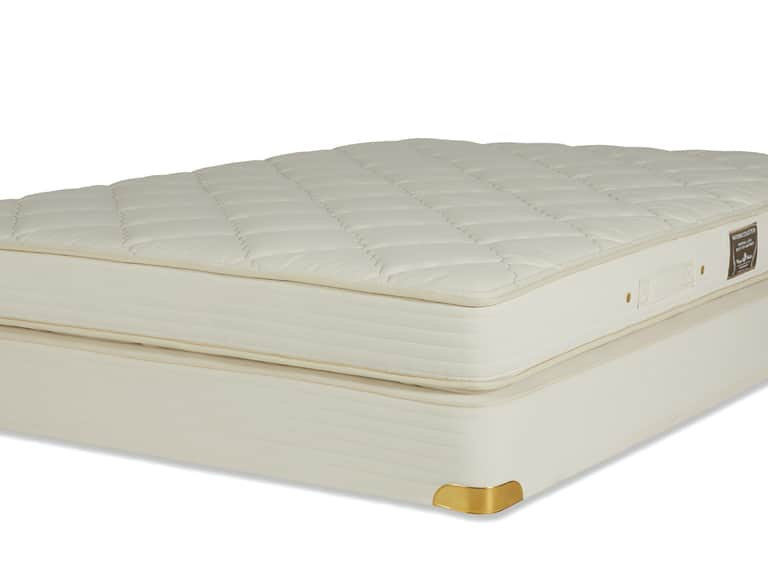
One pad in the bedding selection is described as 100 percent organic cotton inside and out, with two-inch quilted squares and a 220-count percale cover. Its product information states that it is GOTS certified, intended for a standard crib mattress, and machine washable on a cold, gentle cycle, with low tumble drying. It is listed at 28 inches high, 52 inches wide, and 8 inches deep.
Those specifications offer several things a family can evaluate: fiber content, a named certification, construction, dimensions, and a care routine. They do not remove the need to compare the listed dimensions with the actual crib mattress, review the full product instructions, and ensure that the pad lies flat and stays correctly positioned. Product descriptions are a starting point; the physical fit and the manufacturer’s directions remain essential.
The distinction is a useful one. A certified organic cotton pad may appeal to someone who values that material and standard. Its quilting may make it recognizable as a particular kind of bedding. Its washability may be convenient. None of these attributes should be read as a promise that the product will make a baby sleep longer, prevent irritation, or replace a fitted sheet or a firm mattress.
Keeping the crib sleep space uncomplicated
Nursery shopping often rewards addition: another layer, another cover, another solution to a concern that has not yet arrived. For the crib, restraint is more useful. Follow current safe-sleep recommendations and the instructions supplied with the crib and mattress. Keep the sleep area free of loose items and do not add pillows, blankets, soft toys, positioners, or other accessories unless a qualified health professional has specifically advised otherwise in a way that is consistent with current guidance.
A pad’s purpose is limited. It can help protect a mattress and provide a textile surface beneath the sheet, if it is designed for that use and fits correctly. It should not be used to make a firm crib mattress feel softer, to create a raised or contoured surface, or to resolve a sleep or health concern. When a baby’s sleep, breathing, skin, or comfort raises a question, a pediatric clinician is a better source than a product description.
Families may also consult guidance from recognized public-health organizations, including the American Academy of Pediatrics and national health agencies, for up-to-date infant sleep recommendations. Recommendations can be reviewed and updated over time. It is sensible to check current guidance rather than relying on a hand-me-down rule, an online anecdote, or a label that speaks only to materials.
A concise checklist before buying
Before choosing an organic crib pad, pause over a short list of practical questions. The answers do not need to be elaborate, but they should be specific.
- Is the item explicitly made for a crib mattress, rather than an adult bed or a different sleep surface?
- Are the pad’s dimensions compatible with the mattress manufacturer’s specifications?
- Does the pad lie flat and attach as intended without bunching or excess fabric?
- Does the label state the fiber content of both the cover and the filling?
- If a certification is claimed, is the standard identified clearly and is the scope of the claim understandable?
- Can the pad be cared for using a routine that is practical for the household?
- Are the instructions consistent with the mattress and crib guidance?
- Does the finished crib remain simple and aligned with current safe-sleep recommendations?
The quiet value of clear information
The best crib pad is not necessarily the one with the most elaborate story. It is the one whose materials and claims are understandable, whose dimensions suit the intended mattress, whose construction remains intact through care, and whose use does not complicate a safe sleep setup. Organic cotton and third-party certification may be meaningful preferences; they are most helpful when treated as precise information rather than shorthand for every kind of safety or comfort.
In the nursery, cleanliness is less a dramatic achievement than a sequence of ordinary acts: checking a label, washing as directed, letting fabric dry fully, looking over the seams, and making sure the sheet and pad still fit. The work is repetitive by design. A well-chosen pad should make that routine manageable, then return quietly to its place beneath the fitted sheet.
Frequently asked questions
Does an organic crib pad make a crib safer?
No material claim alone establishes that a pad is safe for every crib or makes a sleep environment safer. Fit, intended use, manufacturer instructions, and current safe-sleep recommendations all matter. Organic describes a material or production standard, not a substitute for those considerations.
Is GOTS certification the same as a medical endorsement?
No. GOTS is a textile standard, not a clinical approval or a guarantee that a product will prevent allergies, irritation, or other health concerns. Read the specific certification claim and consult a health-care professional about individual medical questions.
How should an organic cotton crib pad be washed?
Use the care instructions supplied with that specific pad. Some products call for a cold, gentle machine wash and low tumble drying, but care directions vary. Check the fit, elastic, seams, and quilting after laundering.
Can a crib pad replace a waterproof mattress protector?
Not necessarily. Products differ in construction and purpose. Check the description and instructions to understand whether a pad offers moisture protection; do not assume that cotton quilting is waterproof. Any layer used should be intended for the crib mattress and fit correctly.
Can I add a thicker layer if the mattress feels too firm?
Do not use a pad or topper to soften or alter an infant sleep surface. Follow current safe-sleep guidance and ask a pediatric health-care professional if you have concerns about the mattress or your baby’s comfort.